

Our client is a UK equipment hire and sales business. They supply tools, plant and site equipment on hire to trade and construction customers. They run the business on Syrinx, an on-premise Windows hire and sales management system. Customer accounts, contracts, invoices and credit control all live there.
They had also adopted Pipedrive as their CRM, and an independent Pipedrive consultant had set up their pipelines, reports and automations. The sales team worked in Pipedrive, but everything they needed to know about customers was locked in Syrinx.
We built and run a custom integration that brings the client's entire customer base out of Syrinx and into Pipedrive: accounts, contacts, sites, credit control and spend history. Changes sync every 30 minutes, so account managers and directors can see who their customers are and what they spend, without leaving the CRM.
The problem
Two disconnected systems. Who the customer is, which sites they run, who to call, what they spend and whether they're on stop: all of it sat in Syrinx. Pipedrive had none of it.
No spend visibility in the CRM. The team couldn't answer basic questions in Pipedrive. Who are our top accounts? Who spent last year but not this year? Who's over their credit limit?
Manual re-keying wasn't an option. Keeping more than 4,000 accounts and 7,000 contacts current by hand wasn't realistic. Any data typed in would be out of date almost immediately.
Duplicates and messy matching. Some customers already existed in Pipedrive as prospects, often under slightly different names. A simple import would have created duplicates.
No off-the-shelf connector. Syrinx is specialist hire-industry software. There's no Zapier app and no marketplace integration, so we had to learn its web API from scratch.
Strict IT requirements. Before opening up the API, the client's IT team needed firm guarantees:
- read-only access
- traffic from a single known IP address
- light load on a production system
- no copies of their data held anywhere
What we built
We built a small, dedicated sync service, hosted on our own infrastructure and running 24/7. It brings the following into Pipedrive:
- Organisations: every customer account, with name, account number, address, postcode area, website, status (active, on hold or inactive), customer type, depot and salesperson.
- Contacts: every customer contact, linked to the right organisation, with name, job title, emails and phone numbers.
- Sites: each customer's delivery sites and depots, listed on the organisation.
- Finance and credit control: credit limit, balance, overdue amount and aged-debt bands.
- Spend: hire spend and sales spend for the last 12 months, the last 24 months and lifetime, plus total invoiced and the last invoice date and value. Credit notes count as negative.
- Hire history: each customer's hire contract history.
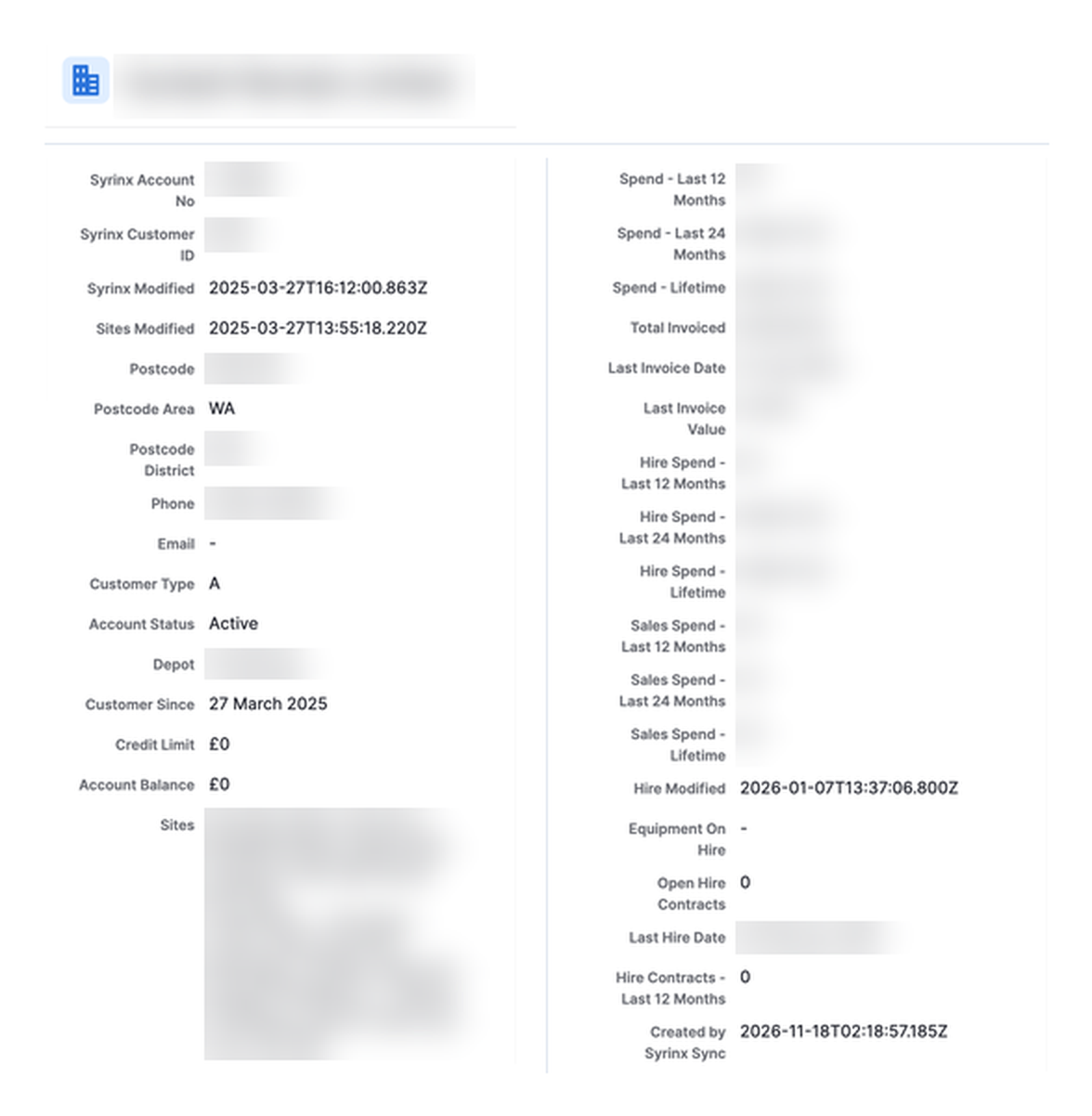
A customer record in Pipedrive, filled in entirely by the integration. Identifying details and spend figures are redacted.
Sync schedule
- Every 30 minutes: a change sync picks up only the records modified since the last run. Each run takes 3–10 seconds.
- Every night: a full refresh recalculates spend from every invoice in about five minutes.
- Initial backfill: the full history, about 4,200 organisations and 7,300 contacts, loaded in roughly 30 minutes, out of hours at a time agreed with the client.
If anything fails, we get an email alert. During the backfill we also sent progress emails.
How it works
1. Read from Syrinx. The service connects to the Syrinx web API from one fixed server address that the client's IT team whitelisted. It only ever reads. The code refuses any other kind of request, and automated tests enforce that rule.
2. Work out what changed. Each run asks Syrinx only for records modified since the last run, which keeps the load on the live system tiny. It fetches pages one at a time, with a pause between each.
3. Match, don't duplicate. Every Pipedrive organisation is keyed on its Syrinx account number, the permanent unique ID the client asked us to use. Existing prospects are matched to their Syrinx account rather than duplicated. Close lookalikes, such as similar names at the same postcode, are held for a person to decide. The integration never guesses.
4. Update only what's different. The service compares what Syrinx says with what's already in Pipedrive and sends only the fields that have changed. A run where nothing has changed writes nothing. Anything the sales team owns, such as notes, activities, deals and their own custom fields, is never touched.
5. Make it reportable. Spend and finance figures go into proper Pipedrive number and currency fields that everyone in the account can see. That meant the client's consultant could build Insights reports on them straight away, without any further integration work. Examples include hire spend over the last 12 months by organisation and owner, spend and account numbers by postcode area, new accounts by month and dormant customers.
Built to pass IT's checklist
We gave the client's IT team these commitments in writing. They are built into the code, not just followed by convention:
- Read-only against the hire system. Nothing is ever written to Syrinx.
- One static IP. All traffic comes from a single whitelisted server, including our own development traffic.
- Light touch. Requests run one after another, never in parallel. Big jobs run only at an agreed time.
- No data stored. There's no database and no cache files. Customer data passes through memory straight into the CRM, and logs hold only IDs, counts and timings.
- Encrypted credentials. Secrets are encrypted at rest on the server and never logged.
- Nothing deleted. Inactive customers are flagged, never removed.
- Dry-run everything. Every write can be rehearsed first to show exactly what would change. We did this before every step on the live CRM.
Results
- More than 4,200 customer accounts and 7,300 contacts are now in Pipedrive, each contact linked to its account, with sites, credit and spend data.
- About 17,000 invoices and 4,000 hire contracts are processed every night into spend figures.
- Account and contact changes reach the CRM within 30 minutes, and spend figures are recalculated every night.
- No duplicates were created. Existing prospects were linked to their accounts. Fifteen ambiguous matches out of more than 4,000 were flagged for a person to decide instead of being guessed.
- No failures in the first week of 30-minute runs and nightly refreshes.
- Spend reporting from day one. The team could see their top accounts by hire spend immediately: about 250 accounts with hire spend in the last 12 months, totalling roughly £1.3M, all reportable in Pipedrive.
- No change to how staff work. Accounts are still opened in Syrinx as usual and appear in the CRM automatically.
What's next
Phase 2: sales intelligence. Spend by month and by product category, order frequency, days since last order, trend flags such as "spend dropping", and products bought versus not bought to spot cross-sell opportunities.
Phase 3: two-way sync. A deal marked as won in Pipedrive will create the customer in Syrinx automatically, and order status will flow back into the CRM.
Technology
- CRM: Pipedrive (API v2)
- Hire and sales system: Syrinx (Web API v1.2)
- Integration: a custom Node.js and TypeScript service, running continuously on a dedicated cloud server in London
- Sync state: stored in custom fields on the Pipedrive records themselves, so there's no separate database to secure and nothing holding client data
- Testing: an automated suite of about 280 tests, run against recorded, anonymised data so tests never touch live systems
- Deploys: every release is built and tested before it goes live
The broader point
Hire and construction businesses often run on specialist industry software with no ready-made connector to anything. That doesn't have to mean a CRM full of stale, hand-typed data. With a careful, read-only integration, the system the business already runs on can keep the CRM complete and current, and the sales team gets the customer picture they need to prioritise accounts, chase lapsed customers and grow spend.
Together with our Glenigan and Barbour ABI integrations for construction sales teams, this is the kind of work we do most. If your business runs on Syrinx or another hire, ERP or industry system and you want that data working inside Pipedrive, this kind of integration is worth a conversation.